


Day 2: Assessment
As introduced in the previous post, starting our program with an assessment would be an essential first step. Keeping track of data will help us monitor progress over time, but the first recorded numbers will act as a baseline where we hope to see improvement over the coming months.
Equipment
We worked with the basics, and despite being a tech geek, I find it easier to jot down and keep track of the numbers the old-fashioned way. I do not own a stopwatch, so my trusty iPhone did the trick.
Notebook and pen
Stopwatch
Soccer cones
100-foot measuring tape
Details
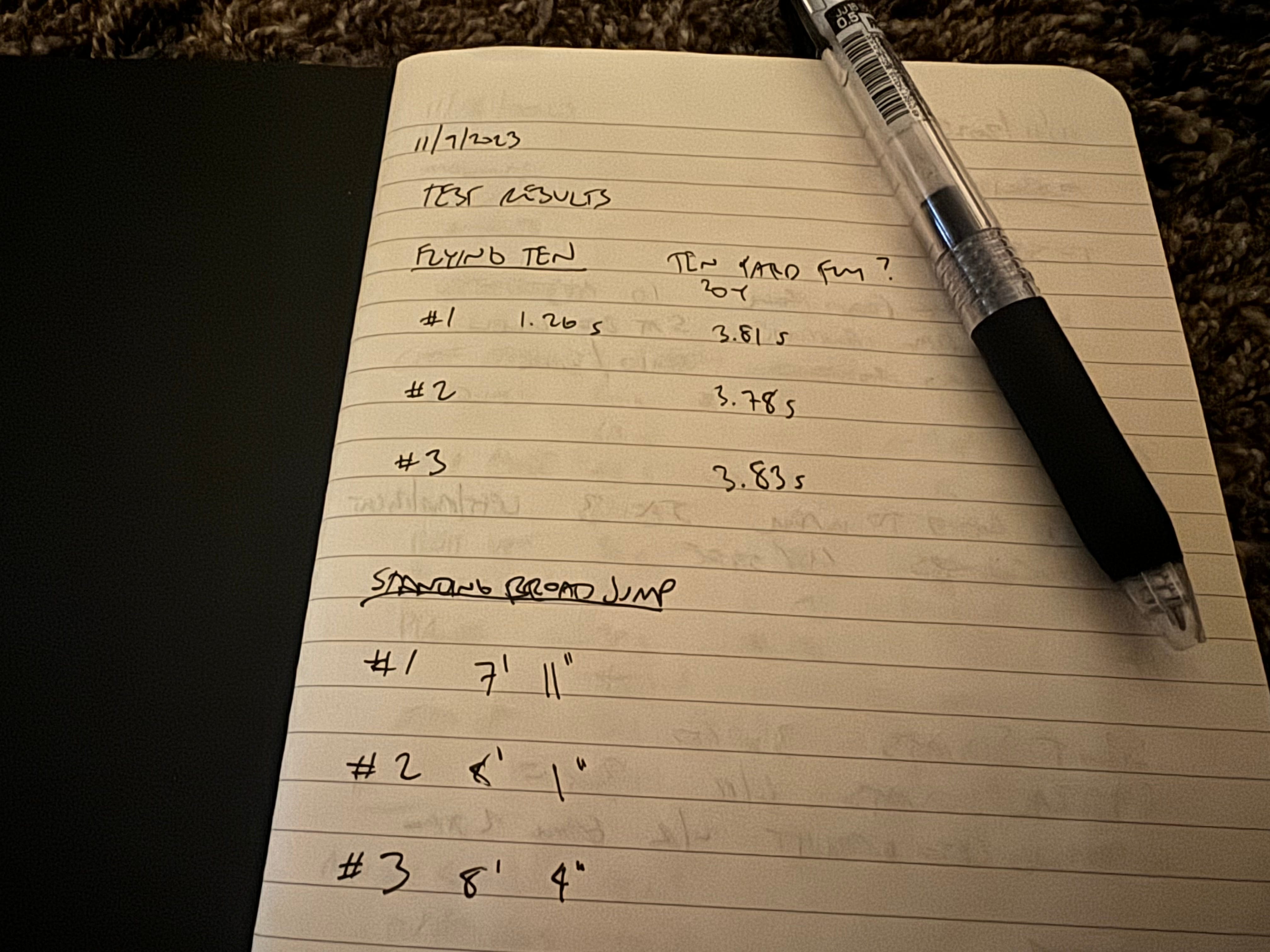
We chose to use the sidewalk in front of our house as our testing site as we are fortunate to have a long, straight stretch of sidewalk with almost no traffic. We went with two tests: the 20-yard dash and standing broad jump. I had my son perform each test three times so I could capture the results and use an average of the three measurements as our scores for the test.
It took some trial and error to decide on the suitable drills, as is evident from my notes in the photo. Become a premium subscriber for all the details of my thought process and the reasoning behind my decisions. I will also share a copy of the spreadsheet I put together to track my son’s results over time.
The following details the thought process behind how I chose to use the type of test for each assessment and the challenges we faced.
Sprint assessment
I first chose the “flying 10” with a 10-yard gradual moving start where you measure the final 10 yards, which should be at full sprint. We made one attempt, and two things were obvious: the result time was under two seconds, and I relied entirely on my reaction time to start and end the timer. If we had a fancy automated timer, we could pull it off, but counting on my response time would not produce reliable results.
We then gave a simple 20-yard dash a try, a simple pivot, as our cones were already set up for the distance. My son started his sprint on my command, and I had more time to adjust to watching the finish. The setup and capturing results were much more reasonable to do this way. He ran three tests, and the times were similar, so we found a winner.
Jump assessment
One note on the jumping test: I read instructions from my Driveline training that said to start the jump with the athlete’s heel at the starting line—growing up, we always started behind the starting line when jumping. Thinking about it, starting with heels at the starting line makes sense as shoe size would not impact the results, whether your kid’s feet grow over time or if you are comparing other athletes to each other.
Aside from that one difference, the jump assessment was simple and required a measuring tape. Having the equipment to measure a vertical jump accurately was not feasible for us, so the standing broad jump was precisely what we needed.
Rotational power assessment
We did not perform tests for this measurement during the assessment. First, we did not have a medicine ball to use yet. For this kind of test, you will need a little soft wall ball variety with some give instead of a solid or slam ball variety. Second, I did not have a radar to measure speed. I wanted to use speed as it would remove variance from not requiring consistent throwing technique between tests.
Saving results
I created a spreadsheet to measure and keep track of progress. Here is a copy of the format that I created—click to view Google Sheet. You may make a copy or download the file and use it for yourself, and of course, feel free to make adjustments to fit your needs.
KPI Template: https://docs.google.com/spreadsheets/d/1xwcv2utJpDm2o58LN4nNyGvwCetmcFHvx_Z0Ieg6Pfw/edit?usp=sharing